


Unit Confusion
- Ian Rainey
- Nov 15, 2017
- 2 min read
When asked the question of how densely radiated an area is or how much radiation is absorbed by a certain medium, there are specific units scientists must use to convey their answers. These units, much like most every other unit, come in different varieties based on which measurement system the scientist or organization chooses to use. The system selection usually comes down to either the metric system or the U.S. customary unit system.
Each unit represents a different value; some represent radiation absorption, some represent ambient radiation, some represent radiation that is given off by different materials. A scientist or student (such as myself) who is studying radiation must be careful to use the units that correspond with the value that is being expressed. Otherwise, the data will be incorrect and is rendered useless until the units are corrected.
Some common units that are tossed around in the radiologist's lexicon are sieverts, rems, rads, grays, curies, becquerels, etc. These may seem like a tangle of strange words with no meaning, but when you get to know them, they become a structured family. This cartoon is pretty helpful in understanding the differences between each unit.

For what it's worth, it is a simple, straightforward analogy, and is backed by academic articles on units. The units for effective and absorbed dosage are explained by the HPS (Health Physics Society), "effective dose...describes the amount of radiation energy absorbed by the body. When scientists describe dose, they use the units of sievert (Sv)…Another dose unit is the gray (Gy)."
As for the metric and customary categorization of each unit, I made a nice table. You're welcome.
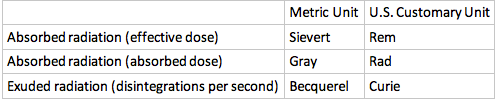
Fantastic, I know. Home grown science right there.
There are also other units, such as the roentgen, but those listed in the table are the most common in scientific data expression. As with any unit, numerical prefixes can be added to change the value of the data, such as the millisievert, microcurie, or millirem. In fact, these prefixes are common with these units because of their extreme sizes, small and large.
I will post a follow-up on the topic of units at a later date.


Comments